.jpg)
FIRST GRADE
Age 6 by September 30 or successful completion of Kindergarten
FIRST GRADE LEARNING GOALS
In First Grade, students deepen their academic skills while continuing to grow as confident, curious learners. Children strengthen communication and collaboration skills as they work with peers and teachers, ask thoughtful questions, and engage in problem‑solving discussions. Literacy instruction builds phonological awareness through direct teaching of spelling patterns and sound relationships, enabling students to spell new words using known rules and read fluently or decode simple sentences and stories. Writing skills advance as students compose well‑structured paragraphs of three to five sentences using complete thoughts, proper spacing, and correct punctuation. In math, students count to 200, solve addition and subtraction problems using multiple strategies, tell time to the hour and practice half‑ and quarter‑hour concepts, and explore fractions and money through interactive lessons. Scientific learning is driven by inquiry, experimentation, and hands‑on exploration, while continued fine motor development and the ability to sustain focus for longer periods support independence and academic readiness.
LEARNING, DISCOVERY, AND FUN IN FIRST GRADE
First Grade combines strong academics with meaningful, memorable experiences. Students participate in hands‑on science experiments, multisensory activities, and creative learning using manipulatives and interactive materials. Weekly enrichment classes—including art, music, physical education, and library—support whole‑child development and foster creativity and curiosity, while two daily recesses provide time for play and movement. Children enjoy school traditions such as Reading Buddies with older students, Principal Time, show‑and‑tell, and special programs including the First Grade Play and Animal Expo. Throughout the year, students take part in field trips, schoolwide celebrations such as Halloween and a Thanksgiving Feast, winter and spring performances, parent involvement events, and end‑of‑year celebrations like the Talent Show and Spelling Bee that highlight confidence, growth, and a strong sense of community.


GETTING READY FOR
FIRST GRADE
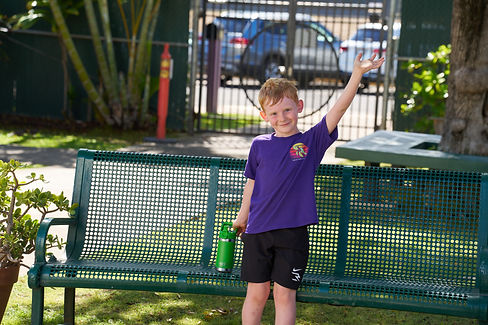
To begin First Grade, students should bring a backpack, a reusable water bottle labeled with their name, a lunch (packed from home or provided through our school vendor), and a change of clothes to keep at school. Students should also have successfully completed an accredited Kindergarten program. All classroom and school supplies are provided by Hale Keiki School.
FIRST GRADE
READINESS SKILLS
Incoming First Grade students should be able to write their first and last name, count to at least 50, and demonstrate an interest in reading, including attempting to sound out or decode simple consonant‑vowel‑consonant words. Students should also display a respectful attitude, the ability to follow directions, and an eagerness to learn and participate in classroom activities.


OUR APPROACH AT HKS
At Hale Keiki School, we prioritize developmentally appropriate practice and meet students where they are. Our experienced teachers thoughtfully design curriculum around each child’s strengths, needs, and interests, ensuring that all students feel supported, challenged, and empowered. This personalized approach allows every child to shine and develop the skills, confidence, and curiosity needed to become a lifelong learner.